Molecular selection and evolution are not global attributes of arbitrary matter. They arise only when molecules possess specific properties—replication, catalytic influence, and heritable variation—that make differential survival and reproduction possible. Without such properties, the integration problem does not even begin.
The Integration Problem
The central question is how independently competitive molecules can be combined into a larger functional unit without ligating them into one large replicative unit. Ligation is constrained by the threshold relation for vₘₐₓ: a single long replicator must keep its replication rate above the error threshold, so integration by fusion is not generally available. Any alternative architecture must satisfy four criteria: joint function, information retention, competitiveness against mutants, and stability against parasitic or dominant subcomponents.
Candidate Architectures
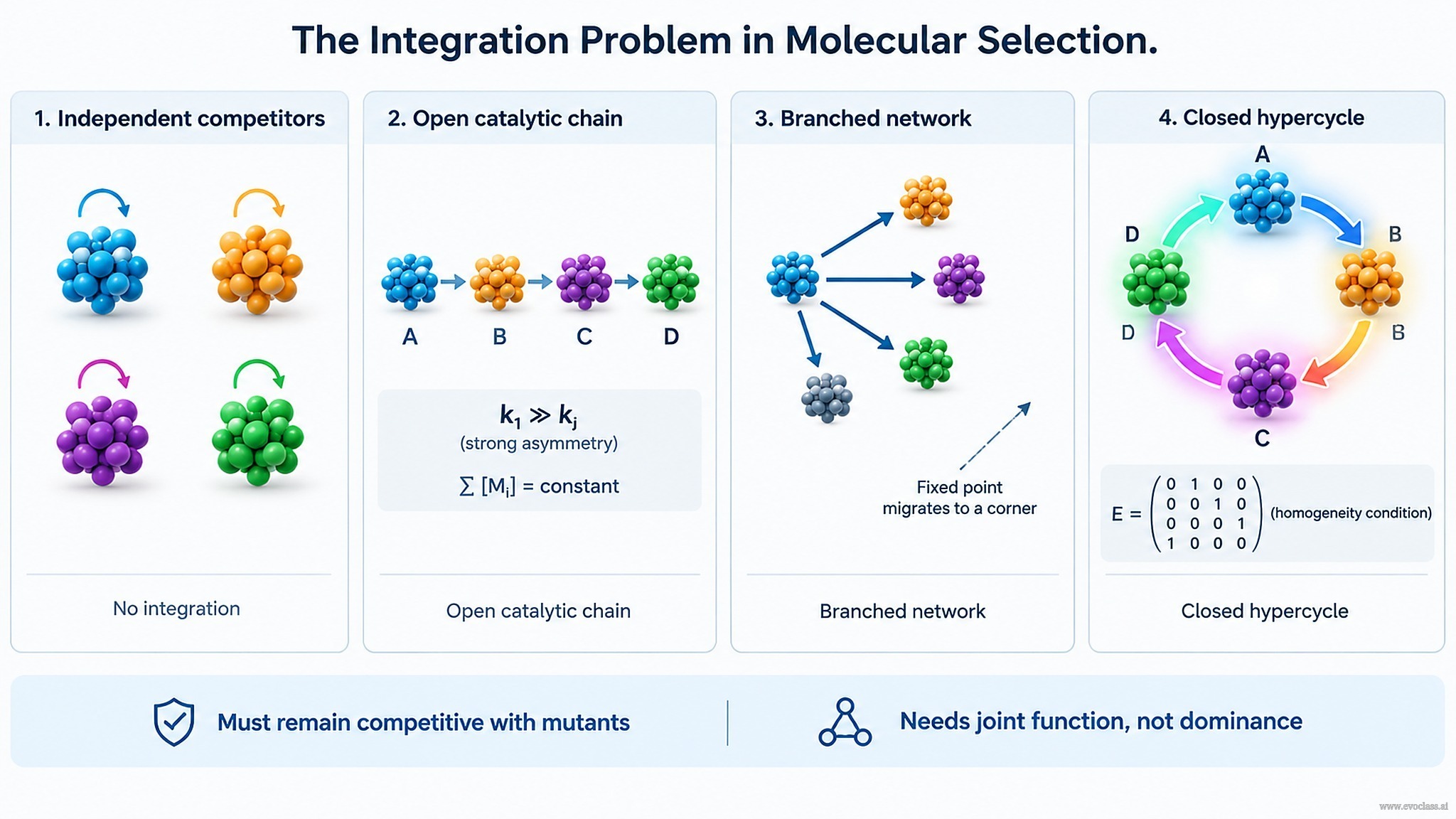
- Open catalytic chains: Under constant organization, an n-membered chain has 2n fixed points. A stable stationary state requires strong asymmetry,
≫ kⱼ ( ,...,n), and total concentration ⱼ₌2ⁿ ( ⱼ)/kⱼ. This is asymmetric dominance, not reciprocal integration; the chain cannot stabilize a joint function. - Branched catalytic networks: In branched coupling, the stable fixed point migrates toward one competing corner of the concentration simplex. The system tends toward dominance by one component rather than balanced joint function.
- Closed hypercycles: Cyclic catalytic coupling defines hypercyclic growth functions through the exponent matrix P. The homogeneity condition is Σ pᵢₖ = p, with cyclic symmetry. Elementary hypercycles have
; compound hypercycles have . These are the remaining candidate for integrating competitive molecules while retaining selection.
Fixed Points and Stability of Hypercycles
For an n-membered hypercycle under constant organization, fixed-point analysis locates a central fixed point at x̄0 = (c0/n)(1,...,1)ᵀ and n corner fixed points. Normal-mode analysis shows the center changing character with dimension: focus for
Integration Routes Compared
Four architectures are contrasted: independent competitors with no integration, open catalytic chains held by asymmetric rate constants, branched networks whose fixed point migrates to a corner, and closed hypercycles with cyclic catalytic coupling. The comparison shows why only a closed hypercycle can, in principle, integrate competitive molecules while preserving joint function and competitiveness against mutants.